Weekly Review / Global Textile & Apparel
Weekly Textile Week 35: Knitwear Rebound, Functional Demand, Textile EPR and a Split U.S. Retail Market
Published: August 30, 2026 | Updated: August 30, 2026
Research window: August 23–29, 2026
Four country stories from Bangladesh, Japan, Germany and the United States show a textile and apparel market moving at different speeds: Bangladesh knitwear rebounded strongly quarter-on-quarter, Japanese department stores saw better apparel demand led by functional summer products, Germany moved closer to a fee-backed textile circularity system, and U.S. retail results split sharply by brand while cotton spot quotations strengthened.

The week in one minute
Four country signals, four different pressures on the same garment.
| Signal | What changed | Why it matters |
|---|---|---|
| Bangladesh knitwear | April–June knitwear exports rose 19.21% quarter-on-quarter to USD 5.50 billion, while woven exports rose only 0.31%. | Bangladesh's latest rebound is being led by knit categories, but energy reliability and yarn policy can still change delivered cost and lead time. |
| Japan apparel | July department-store apparel sales rose 3.9% year-on-year; cooling, UV-cut, T-shirts, cut-and-sew tops and pants were reported strong. | Functional value is being added to basic apparel categories rather than only to technical sportswear. |
| Germany textile EPR | Textile and retail associations launched an alliance as Germany prepares implementation of extended producer responsibility for textiles. | Product composition, traceability, recyclability and data quality are moving closer to direct commercial requirements. |
| U.S. retail + cotton | Gap brand comparable sales rose 10%, while Old Navy fell 4% and Athleta 12%; USDA base-quality spot cotton averaged 82.88 cents/lb, up 293 points week-on-week. | U.S. demand is selective rather than uniformly weak, while firmer cotton adds a separate costing risk. |
Story 1 / 04
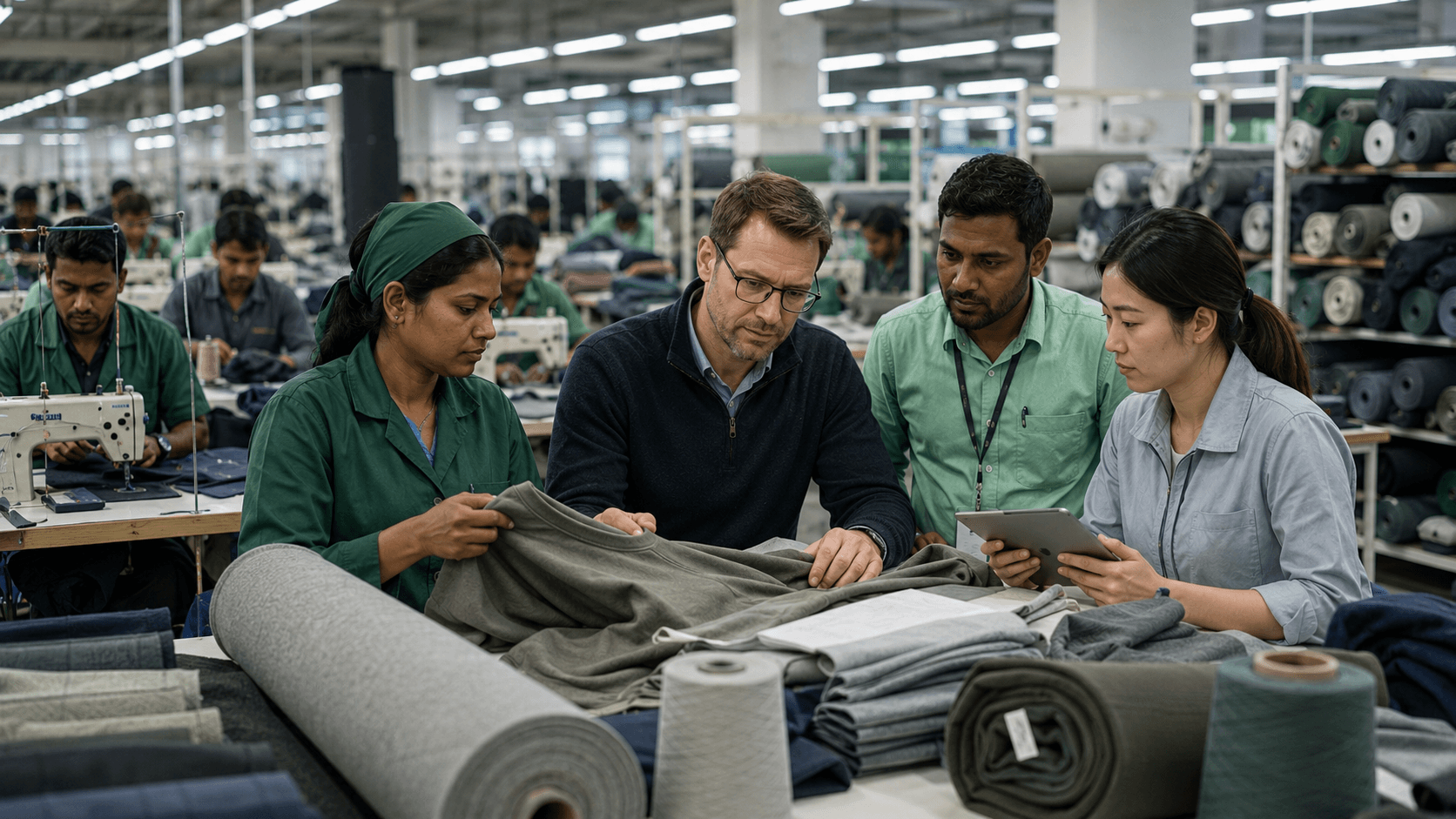
Bangladesh knitwear rebounds much faster than woven apparel
Bangladesh Bank published its latest Quarterly Review on RMG on August 25. Reporting based on the review shows net RMG export earnings of USD 6.23 billion in April–June 2026, up 10.38% quarter-on-quarter from USD 5.64 billion in January–March.
Gross RMG export earnings increased 9.79% quarter-on-quarter to USD 10.10 billion.
The category split is more important than the overall rebound. Knitwear exports rose 19.21% quarter-on-quarter to USD 5.50 billion, from USD 4.61 billion. Woven garment exports increased only 0.31% to USD 4.60 billion, from USD 4.58 billion.
RMG raw-material imports were reported at USD 3.87 billion, equivalent to 38.32% of gross RMG export earnings. That left reported value addition at 61.68%, slightly above 61.35% in the previous quarter.
The rebound does not remove Bangladesh's operating risks. Industry reporting during the same week continued to highlight gas and power disruption. A separate August 24 Bangladesh–India trade meeting also brought yarn sourcing back into focus: the two sides discussed lifting Bangladesh's restrictions on Indian yarn imports through land ports.
Weekly Textile reading
The useful signal is not simply that Bangladesh exports rose. It is that knitwear recovered far faster than woven garments in the latest quarter.
That strengthens Bangladesh's position in categories such as T-shirts, polos, knit bottoms, fleece and other circular-knit programs, but buyers should not treat the export rebound as proof that upstream supply is stable. Yarn access, gas availability, dyeing and finishing capacity can still change quote validity and production calendars.
The yarn-import discussion matters for the same reason. Easier land-port access to Indian yarn could improve sourcing flexibility for some garment exporters, while local spinners are likely to keep pressing for protection. No policy change should be treated as final until the government formally announces it.
Story 2 / 04
Japan's department stores show stronger apparel demand, led by functional summer basics
The Japan Department Stores Association released its July 2026 nationwide sales report on August 25.
Total department-store sales were JPY 488.9 billion, up 5.1% year-on-year after adjustment for store-count changes. Apparel sales totaled about JPY 118.8 billion, up 3.9%.
Within apparel, men's clothing and accessories rose 1.6%, women's clothing and accessories 4.3%, children's clothing and accessories 5.8%, and other apparel 4.7%.
The association linked stronger summer-goods demand to intense heat from mid-July. In apparel, it specifically highlighted contact-cooling and UV-cut functional products, while T-shirts, cut-and-sew tops and pants also performed well.

Weekly Textile reading
Japan's signal is useful because the products are not exotic. Basic apparel is gaining value through thermal comfort, UV protection and reliable everyday performance.
For exporters, that can translate into more buyer attention to fabric handfeel, moisture and heat management, UV functionality, wash durability, shrinkage, pilling, colourfastness and clean construction—even on otherwise simple T-shirts and knit tops.
The limitation is important: these are department-store sales, not total Japanese apparel consumption, and July demand was helped by unusually hot weather. The data should therefore be read as a channel-specific product signal rather than a national forecast.
Story 3 / 04
Germany moves from textile-circularity policy toward the operating design of EPR
On August 26, the German Textile and Fashion Industry Association (Gesamtverband textil+mode) and the German Retail Federation (HDE) announced the formation of the Alliance for Textile Cycles.
The alliance is intended to help shape Germany's implementation of EU extended producer responsibility, or EPR, for textiles.
The HDE announcement says a corresponding German bill is in preparation and that, for the first time, companies placing textiles on the German market are expected to pay fees for their later disposal.
The two associations are calling for a practical system with clear architecture, transparent and causation-based cost allocation, legal certainty, European harmonisation and equal treatment of international platforms and third-country sellers.

Weekly Textile reading
For exporters, the commercial issue is not the alliance itself. It is the direction of travel.
When brands and importers become financially responsible for the post-use phase of garments, they have a stronger reason to ask suppliers for accurate fiber composition, product weight, trim information, durability evidence, recyclability information, material traceability and consistent product data.
The final German fee formula, eco-modulation rules and implementation details are not yet established in this source. Suppliers should prepare data systems now, but they should not assume a final cost per garment or legal start date until Germany publishes the legislation.
Story 4 / 04
U.S. apparel demand splits sharply by brand while cotton cost pressure rises
U.S. apparel-company results released this week do not support a simple ‘strong consumer’ or ‘weak consumer’ conclusion.
Abercrombie & Fitch reported record second-quarter net sales of about USD 1.27 billion, up 5% year-on-year. Abercrombie brand-family sales rose 8%, while Hollister rose 2%. The company updated its full-year outlook to net-sales growth of around 5%.
Gap Inc. reported company-wide comparable sales down 1%, but the brand split was wide. Gap comparable sales rose 10%, Banana Republic rose 3%, Old Navy fell 4%, and Athleta fell 12%. Gap said its namesake brand continued to perform strongly in destination categories including denim, fleece, kids and baby.
Kohl's reported net sales and comparable sales both down 0.9% in the second quarter.
A separate raw-material signal moved in the opposite direction. USDA's Weekly Cotton Market Review for the week ending August 27 said spot quotations for base-quality cotton averaged 82.88 cents per pound, 293 points higher than the previous week's 79.95 cents. Daily averages reached a season high of 85.85 cents on August 27.

Weekly Textile reading
The U.S. story is selection, not uniform weakness.
Consumers are rewarding some brands and categories while rejecting others. For suppliers, that raises the value of product development, category relevance, fast replenishment and the ability to support buyers that are concentrating orders behind proven styles.
Gap's denim, fleece, kids and baby strength is particularly relevant to apparel manufacturers because those are sourcing-intensive categories rather than purely luxury or accessories businesses.
The cotton figure requires a separate caveat. USDA's 82.88 cents/lb number is a base-quality U.S. spot quotation, not the same thing as ICE cotton futures and not a direct yarn offer. Spot trading was also thin. It is nevertheless a useful warning that raw-material quotations can move quickly even while retail demand remains uneven.
Weekly Textile assessment
Week 35's clearest message is that the same garment is being judged by four different market pressures:
Bangladesh
Knitwear exports have regained momentum, but yarn sourcing and utility reliability still affect execution.
Japan
Functional value is being built into basic apparel through cooling, UV and comfort performance.
Germany
Circularity is moving closer to a fee-backed operating system, increasing the commercial value of accurate product data.
United States
Demand is concentrating behind winning brands and categories while cotton costs can still move independently of retail sentiment.
What to watch next week
- Whether Bangladesh formally changes land-port yarn-import rules and whether gas availability improves for spinning, dyeing and finishing.
- Whether Japan's August apparel data confirms demand beyond the July heat-driven functional-product boost.
- The German EPR draft: scope, producer definition, fee calculation, eco-modulation and treatment of online platforms.
- U.S. back-to-school sell-through and whether the divergence between strong and weak apparel brands narrows or widens.
- Whether U.S. cotton spot quotations hold above the previous week's level or reverse after the sharp rise.
Weekly takeaway
Week 35 is not a ‘textile demand up’ or ‘textile demand down’ story.
Bangladesh shows a production-side knitwear rebound. Japan shows a product-function signal. Germany shows a compliance-and-data signal. The United States shows a brand-selection signal with a separate raw-material warning from cotton.
For sourcing teams, that means quotations increasingly need to explain more than FOB price: fabric construction, GSM, fiber composition, function, test performance, traceability, production timing and price validity are becoming part of the commercial argument.
Editorial note: Weekly Textile translates and summarises original local-language reporting where required. Company earnings describe individual retailers, not the whole U.S. apparel market. Department-store data do not represent all Japanese apparel sales. German EPR implementation details remain under development. USDA spot cotton is not the same measure as ICE futures or a mill yarn quotation.