Week 31 · July 26–August 1, 2026
Asia–South America Textile Signals: Flexible Supply, Weaker Production and New Tariff Pressure
Published: August 1, 2026 | Updated: August 1, 2026
Research window: July 26–August 1, 2026
China is making its textile supply chain more accessible to smaller international buyers, while Vietnam is trying to reduce its dependence on imported fabrics and accessories. South Korea’s apparel market is showing a split between recovering consumption and weak domestic production. Argentina’s textile contraction is deepening, and Peru’s exporters face a new tariff disadvantage in the United States.
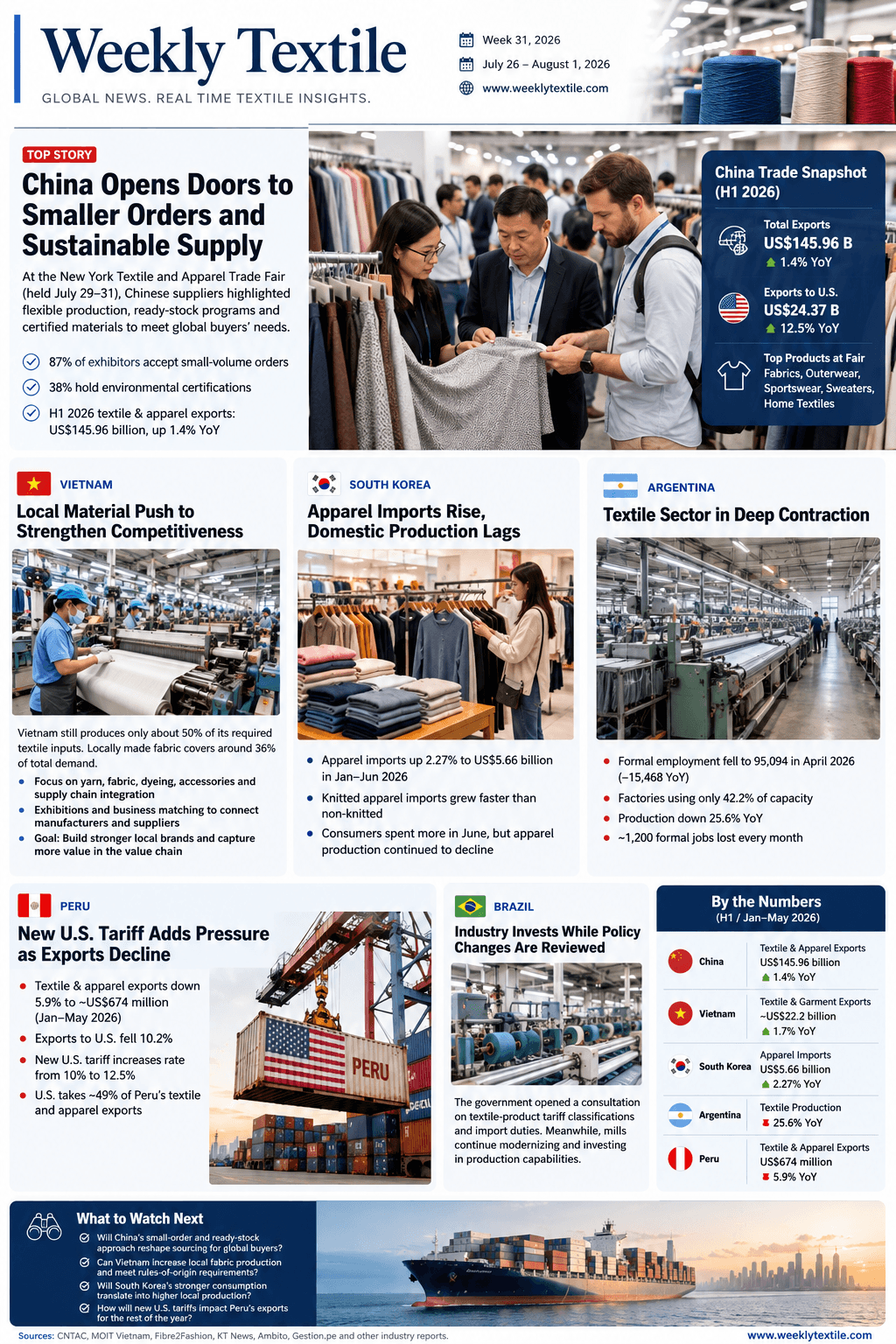
Week 31 summary
China is making its textile supply chain more accessible to smaller international buyers, while Vietnam is trying to reduce its dependence on imported fabrics and accessories. South Korea’s apparel market is showing a split between recovering consumption and weak domestic production. Argentina’s textile contraction is deepening, and Peru’s exporters face a new tariff disadvantage in the United States.
This week’s key signals
Story 1 / 05
China presents a more flexible supply chain
The 2026 China Textile and Apparel Trade Fair opened in New York on July 29 with more than 410 exhibitors from 19 countries and regions. More than 300 participating companies came from China.
According to the China National Textile and Apparel Council, 87% of participating Chinese companies could accept small-volume orders, while 38% held environmental certifications. Some suppliers also offered ready-stock products for faster delivery.
China’s textile and apparel exports reached approximately US$145.96 billion in the first half of 2026, up 1.4% year on year. Exports to the United States increased 12.5% to US$24.37 billion.
Story 2 / 05
Vietnam focuses on materials and stronger local supply chains
Vietnam’s Ministry of Industry and Trade reported on July 29 that the country’s textile industry still produces only around 50% of required input materials locally. Domestically manufactured fabric satisfies approximately 36% of demand.
Reliance on imported yarn, fabric, chemicals and accessories leaves manufacturers exposed to supply disruption and can complicate compliance with rules of origin under newer free-trade agreements.
Vietnam is using exhibitions and business-matching programmes to connect garment factories with fibre, weaving, dyeing, finishing and accessory suppliers while encouraging product development and domestic brand-building.
Story 3 / 05
South Korean garment demand improves, but production remains uneven
South Korea’s apparel imports increased 2.27% to approximately US$5.66 billion during January–June 2026. Imports of knitted apparel grew faster than non-knitted garments.
At the same time, exports of South Korean man-made filament products and knitted or crocheted fabrics weakened. Local reporting also showed that clothing consumption improved in June while domestic apparel production fell sharply.
Story 4 / 05
Argentina’s textile sector loses around 1,200 jobs per month
Formal textile employment fell to 95,094 positions in April 2026, representing 15,468 fewer jobs than a year earlier. Industry activity declined 25.6% year on year, while factories were using only 42.2% of available machinery and production capacity.
Around 330 textile-related factories and registered establishments reportedly disappeared over the same one-year period.
Story 5 / 05
Peru’s exporters face a higher tariff in their main market
Peruvian textile and apparel exports fell 5.9% to approximately US$674 million through May 2026. Exports to the United States declined 10.2%.
The United States receives around 49% of Peru’s textile and apparel exports. A new tariff arrangement raises the applicable rate for affected Peruvian products from 10% to 12.5%.
What to watch next
- Whether Chinese small-order capabilities change sourcing patterns among independent brands.
- How quickly Vietnam can expand local fabric and accessories.
- Whether South Korean consumer demand supports local output.
- Whether Argentina records further factory closures.
Weekly takeaway
The gap is widening between countries adapting their supply chains and those facing industrial contraction. China and Vietnam are building flexibility and value-added capability. South Korea has demand but weaker production. Argentina and Peru face the sharpest immediate pressure.
Frequently asked questions
Which market showed the strongest garment-import demand?
South Korea recorded modest growth in apparel imports, led by knitted categories.
Which country faces the greatest immediate industrial pressure?
Argentina showed the most severe deterioration in domestic production, utilisation and employment.
Which market faces the clearest new trade-policy risk?
Peru, because the United States purchases almost half of its textile and apparel exports.
Sources
- China National Textile and Apparel Council
- Vietnam Ministry of Industry and Trade
- Fibre2Fashion
- Korea Textile News
- Ámbito
- Gestión